

In the stark, brutalist mansion in Pedregal, dawn shattered with a scream that sounded almost inhuman. Little Leo, only seven years old, twisted in his silk-covered bed, clutching the sheets as waves of pain coursed through him.
His father, Roberto—a powerful millionaire who could solve any business crisis—sat helplessly beside him, tears wetting his palms. A team of neurologists studied Leo’s MRI scans once again, repeating the same cold conclusion:
“Nothing physical, sir. The brain is intact. His condition appears psychological.”
But Maria, the new nanny—an indigenous woman with calloused hands and quiet wisdom—noticed what the expensive machines did not. She saw the cold sweat on Leo’s brow, the way he curled into himself, the way his tiny fingers always drifted toward the top of his head as if pointing to a hidden source of pain.
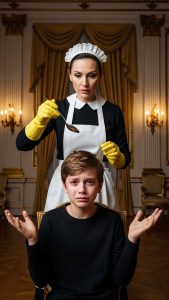
Leo’s stepmother, Lorena, had introduced strict rules to protect his “fragile nerves”—no touching without gloves, no hugging, no warmth. Leo lived surrounded by sterile protocols rather than affection. Everyone believed Lorena’s diagnosis of extreme sensory hypersensitivity, but Maria felt something was wrong. Deeply wrong.
In the fleeting moments when Leo’s sedatives wore off, Maria noticed a pattern: his hand always returned to the same small spot on his scalp beneath the thick wool hat he wore at all times—even in the sweltering heat of Mexico City. Lorena insisted the hat was to protect him, and no one but her was allowed to remove it.
But to Maria, it felt less like protection and more like secrecy.
One afternoon, while changing the sheets, the hat slipped for a moment. Maria caught a glimpse of irritated skin near Leo’s hairline—red, inflamed, and clearly painful. Lorena quickly appeared and yanked the hat back into place, her smile strained. “Don’t touch him,” she warned sharply.
Maria said nothing, but her instincts sharpened.
Days later, while Roberto was in a meeting and Lorena away at a charity event, Leo collapsed again in agony, clawing at his hat. With no doctors around and no stepmother to interfere, Maria knew this was the moment to act.
She locked the door gently, knelt beside the child, and whispered, “I’m here, sweetheart. I won’t hurt you.”
Ignoring the rule against touching him, she removed her gloves and placed her warm hand on his trembling shoulder. Then, with great care, she loosened the wool hat.
What she found was not a monstrous secret—no conspiracy, no cruelty—just a simple, devastating oversight.
The hat had been poorly constructed. A stiff piece of plastic from the inner seam had broken through and was pressing directly into Leo’s scalp. Every time he moved, the plastic dug deeper, irritating the same sensitive spot again and again. The pressure and pain mimicked neurological symptoms, tricking doctors into assuming a psychological disorder.
Maria cleaned the irritated skin with a warm herbal infusion she brought from home, something her grandmother had used to soothe her own children. Leo let out a soft, relieved whimper.
In that moment, Roberto burst into the room, panic twisting his features. But when he saw Leo calm in Maria’s arms and the broken piece of plastic in her hand—his expression shifted from fear to stunned realization.
All this time, the suffering had come from something simple. Something avoidable. Something overlooked in a house obsessed with protocols.
When Lorena returned, shaken by the discovery, her façade cracked. Her intentions had never been malicious—only rooted in overwhelming fear of failing as a stepmother. She had relied too heavily on medical warnings she barely understood, creating a world of restrictions that unintentionally worsened Leo’s condition.
Tears streamed down her face as she apologized. Roberto embraced her gently, understanding now that her mistakes came from anxiety, not cruelty.
From that day forward, the family changed. The sterile rules were replaced with gentler care. Leo received affection again—hugs, laughter, fresh air. Maria stayed on as a trusted caretaker, her intuition and kindness now valued as much as any medical opinion.
Three months later, the mansion no longer smelled of antiseptic. It smelled of food, flowers, and life. Leo kicked a soccer ball across the garden, his hair free in the breeze, the small scar on his scalp the only remaining sign of his ordeal.
Maria watched him with a soft smile, knowing she had helped restore not just a child’s health, but a family’s humanity.
And Roberto understood something he had never learned in business:
Sometimes the greatest healing comes not from machines or money—but from a pair of caring hands and a heart that sees what others overlook.



0 Comments