
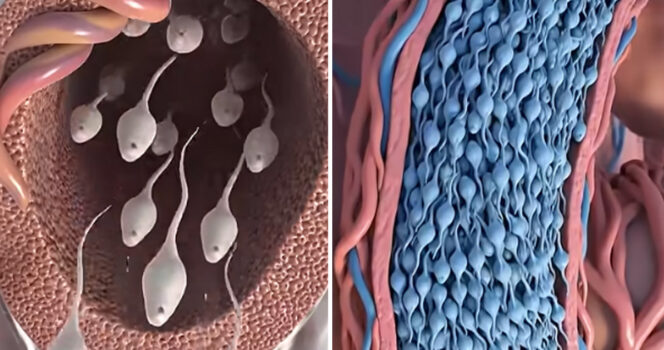
A scientific simulation explains exactly what happens when sperm doesn’t leave the body.
Sperm production usually starts between the ages of 10 and 13 and continues throughout a man’s life. Some might think semen just hangs out in the body indefinitely unless released – but that’s not the case.
During ejaculation, a healthy man produces roughly two to five millilitres of semen, according to the Open University. The Cleveland Clinic explains: “A tube at the back of your testicle (epididymis) stores sperm until it matures. Your sperm then combines with seminal vesicle fluid and prostate fluid to create semen.”
Even if it’s not something most men think about every day, our bodies are constantly working, and sperm production is no exception. So what happens if sperm never gets released?
This happens if sperm never gets released
A scientific simulation shows exactly what occurs, with Dr Smurf on YouTube demonstrating the role of the epididymis, a tube that wraps around the testes.
Sperm begin life in the testicles and then move to the epididymis, where they remain until ejaculation. They have a shelf life of around 74 to 76 days; after that, they expire.
Rather than going “bad,” sperm go through a process called degeneration, according to UNILAD. This means they break down and are reabsorbed by the epididymis, with their proteins recycled to help produce new sperm.
Sperm cells are packed with structural components like enzymes, zinc, and fructose. If they aren’t reabsorbed, they eventually leave the body. The body “may also release the sperm during nocturnal emission, also known as a wet dream,” Medical News Today explains.
Low sperm count
Sometimes, ejaculation doesn’t happen as easily as it should, and some men struggle with low sperm count. The Mayo Clinic lists several factors that can interfere with sperm production, including:
- Varicocele
- Infection
- Tumors
- Undescended testicles
- Hormone imbalances
- Changes in the tubes that carry sperm
- Genetic conditions
- Certain medicines
- Prior surgeries
Like most body-related issues, stress, drug and alcohol use, psychological well-being, and overall health also affect sperm count and sexual health.
Benefits of regular ejaculation
In recent years, the trend “No Nut November” has drawn global attention. It stems from the belief that abstinence boosts sperm quality and testosterone – a myth doctors have consistently dismissed. Instead, Medical News Today notes that extended periods without ejaculation may contribute to anxiety or depression.
Some research even highlights the benefits of regular ejaculation. A Harvard study found that men who ejaculated 21 times or more per month had a 31 per cent lower risk of prostate cancer.
“The results held up to rigorous statistical evaluation even after other lifestyle factors and the frequency of PSA testing were taken into account,” the study said, according to UNILAD.



0 Comments