

Was Tricked Into a Blind Date With a Paralyzed Woman — They Never Expected My Reaction
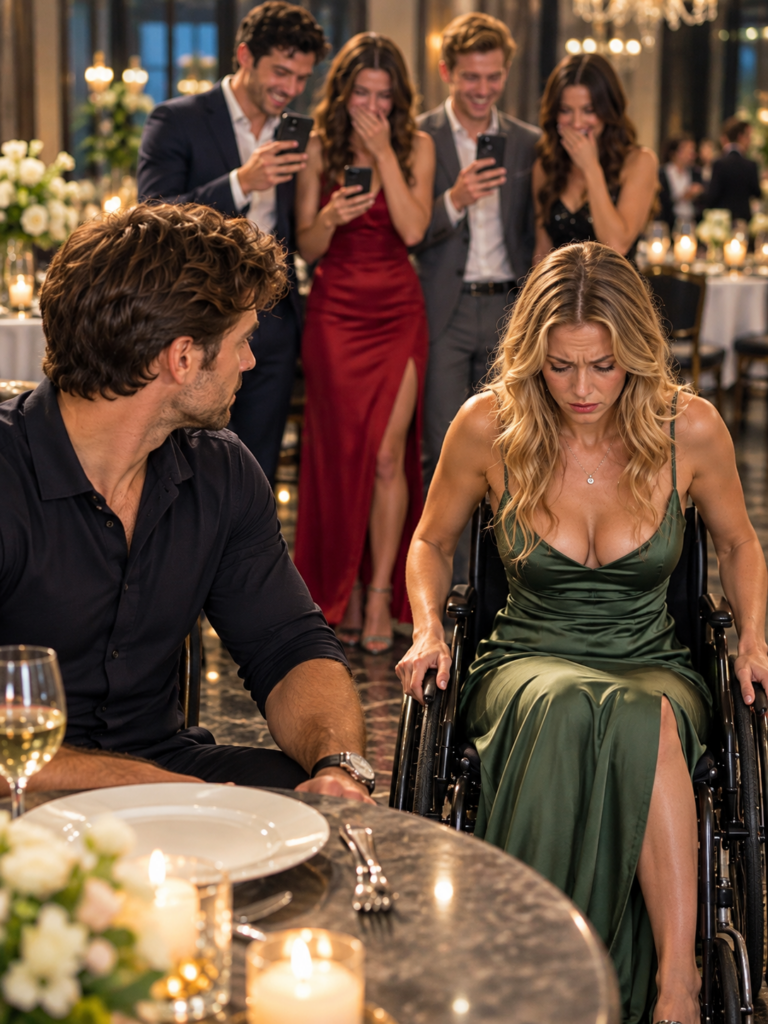
“We didn’t tell him about the wheelchair,” I heard my best friend say. “We needed to know what he’d do.” I was standing ten feet away, still deciding whether to introduce myself. Across the rooftop restaurant, Ellie Navarro sat alone beside the railing while five people who claimed to care about us watched from hiding places. I could have turned around. After all, my friends had managed to make me feel like a suspect before I’d even ordered dinner. But Ellie looked up, caught me staring, and raised one eyebrow. Then she said something that made leaving considerably harder.
My Friends Turned Our Blind Date Into a Secret Test
The first thing Ellie Navarro said to me was, “If you’re here for the bread, you’re late. I’ve already stolen the best roll.”
I noticed her yellow sundress, the pencil tucked into her curls, and the wheelchair beside the table. “I was going to ask if this seat was taken,” I said, “but apparently we’ve skipped introductions and gone straight to theft.”
“Depends. Are you Jared?”
“Unfortunately for both of us.”
She laughed. I hadn’t dated in eight months, and before that my romantic history resembled something abandoned at the bottom of Charleston Harbor.
I’m Jared Whitlock, thirty-three, a Charleston boat mechanic. I’m good with diesel engines, terrible at romantic texts, and suspicious when friends say trust us. That afternoon, Brent told me to wear a clean shirt and meet Ellie at the Salty Pelican at seven. Kayla said she illustrated books. Owen said she loved the water. None mentioned the wheelchair.
That omission wasn’t what bothered me. The audience was.
At thirty-three, I’d grown used to my friends acting like my bachelorhood was a boat they could repair one Sunday. I laughed when they teased me about it. Seeing another person pulled into their project made the joke feel different.
Brent, Kayla, and Owen sat at the rooftop bar, pretending to study a drink menu. Brent spotted me and ducked, nearly knocking over his beer. Ellie followed my glance.
“Please tell me those aren’t your friends,” she said.
“I’d prefer not to, but I have photographic evidence.”
She nodded toward a potted palm. A woman with Ellie’s curls watched us over a wineglass. Beside her, a man hid behind an upside-down menu.
“My sister Maya and my friend Dev,” Ellie said. “Apparently we’re both under surveillance.”
I sat back. “Did you know about this?”
“I knew Maya was worried. I specifically told her not to come.” She rubbed her forehead. “I didn’t know she was bringing backup.”
A server arrived with water and the expression of someone approaching a difficult table. I ordered iced tea; Ellie ordered lemonade. We waited until she left.
“Did they tell you I use a wheelchair?” Ellie asked.
“No.”
Her expression tightened. She’d heard that answer before. She rolled the paper sleeve from her straw into a tight coil. It was a small gesture, but I understood what it cost her to sit through another stranger’s reaction while people she loved watched for signs of trouble.
“I thought they had,” she said. “I told Maya I didn’t want another guy being surprised across an appetizer.”
“Is that what happened before?”
“Once. The guy spent twenty minutes telling me about his cousin’s physical therapy. I never got to finish my crab cakes.”
At the bar, Kayla looked away.
“I should probably talk to them,” I said.
“Please don’t start a fight on my account.”
“I’m going to try something much worse. An honest conversation.”
She watched me stand, then smiled despite herself. “Good luck. They’re organized.”
At the bar, Brent greeted me with a cheerful “Hey, man!” that fooled nobody.
“You knew she didn’t know what you were doing,” I told him.
Kayla put down her glass. “Jared, hear us out.”
“I’m listening.”
Brent glanced toward Ellie’s table. “Her last boyfriend made everything about her accident. Maya wanted to make sure you weren’t like that.”
“And you figured I’d behave more naturally if three people were grading me?”
Owen winced. “It sounds bad when you say it out loud.”
“It was bad before I said it.”
Kayla sighed. “Ellie agreed to a blind date. Not this. I should have stopped it.”
I’d known Brent since high school. Kayla had brought soup after my mother’s surgery. Owen once helped tow a stranded boat at midnight. They weren’t cruel people, but they’d mistaken good intentions for permission.
“Go apologize to Ellie,” I said. “Then invite the people behind the palm over. If you’re all so interested in our dinner, you can pay for appetizers.”
Ten minutes later, we pushed two tables together. Maya Navarro, a prosecutor, looked as if she’d prepared an opening statement. Dev, an art teacher, admitted he’d panicked with the menu.
“Are you always this charming?” Maya asked.
“Only when I’m being investigated between the hushpuppies and the entrée.”
Ellie choked on her lemonade. Dev laughed. Maya’s mouth moved a fraction toward a smile.
Dinner grew unexpectedly lively. Brent and Maya argued about parking. Dev dismantled Owen’s dating theory with a napkin sketch. Kayla apologized to Ellie without asking for reassurance.
Ellie and I talked between interruptions. She drew children’s books and illustrated museum exhibits. Three years earlier, a riding accident had injured her spinal cord. She mentioned it plainly, then complained that Charleston’s prettiest benches were impossible to sit on comfortably.
I told her how a charter captain once paid me to remove a shrimp from an engine compartment. She asked whether the shrimp had been licensed to operate the boat.
At nine-thirty, Maya pulled me aside near the elevator. “Ellie’s had people make promises they didn’t keep,” she said.
“I have, too.”
“Then don’t make one tonight.”
I wanted to tell her to stop treating her sister like a case file. Instead, I said, “Ask Ellie what she wants from me.”
Maya considered that. She didn’t apologize, but she stepped aside.
When the others left, Ellie stayed by the railing. Harbor lights cut silver lines through the water.
“I’m sorry they turned us into a project,” I told her.
“Me too.” She looked up. “Can I confess something?”
“Is it about the bread?”
“They told me you were afraid to get serious with anyone. And they told you nothing about the most obvious part of my life.” She hesitated. “It feels like everyone came here expecting one of us to run.”
I thought of how close I’d come to leaving. “Well,” I said, “we’re still here.”
“That’s one evening, Jared.” Her voice wasn’t cold. It was careful. “I need to know whether you’ll still want to be here when it isn’t fun.”
A Walk Along the Harbor Made Our First Real Promise
I didn’t answer Ellie’s question with a speech. We’d met four hours earlier. Anyone promising forever over a restaurant railing was either selling something or dangerously confused.
“I’d like a second date,” I said. “Beyond that, we could try telling each other the truth.”
Ellie studied me, then reached for her bag. “Good answer. Walk with me?”
We headed toward the Battery. Charleston in June smelled like saltwater, warm brick, and somebody’s late dinner. Ellie navigated a cracked sidewalk before I could offer help.
“My accident was three years ago,” she said. “Horse threw me. I was twenty-nine, working on my first picture book, sure I had plenty of time.”
“Did you finish the book?”
“Two, actually.” She smiled. “I don’t mind questions about my chair. I mind when people forget there are other answers.”
Under a streetlamp, I asked to kiss her. She said yes, and afterward leaned against me, laughing.
“That’s better than the bread,” she said.
I drove home grinning. I kept replaying her question from the rooftop. I didn’t know whether I could be what she needed, or whether she would like the person I was on a difficult Tuesday. For once, I wanted to find out.
Ellie planned our second date at the community sailing club. She told me to bring sunscreen and humility. I arrived expecting to rig the boat. She’d already checked the accessible dock, adjusted the adaptive seating, and reviewed the forecast with Gus, her instructor.
“You work on boats?” Gus asked.
“Every day.”
“Then maybe you can keep up.”
Gus was seventy-two, a retired minister who swore like a dockworker.
Ellie took the tiller, issuing instructions without concern for my dignity. She’d learned adaptive sailing after her accident. Out there she was relaxed and fiercely competitive. I made one questionable knot and heard about it for forty minutes. She let me steer for five minutes, then reclaimed the tiller when I headed toward a crab trap. I accused her of setting me up. She said I was doing an excellent job embarrassing myself without assistance.
At the dock afterward, a gust pushed her chair slightly sideways as she transferred back. I reached for its handles. She caught my wrist before I touched them.
“Ask first,” she said.
I withdrew my hand. “Sorry. Reflex.”
“I know. But I need you to listen when I say I’ve got it.”
She completed the transfer. I was embarrassed, not offended.
“Do you want me to hold your bag?” I asked.
“That,” she said, handing it over, “would be wonderful.”
A week later, I watched her illustrate a stubborn sea turtle at her kitchen table. She had ink on her wrist and an overdue electricity bill beside her laptop.
I invited her to dinner Friday, then remembered the three steps to my porch.
“I can figure something out,” I said quickly.
Ellie set down her pencil. “Can we figure it out together?”
I agreed. Later, I wondered why I’d assumed the solution should be mine alone.
My Good Intentions Became Exactly What Ellie Had Feared
My house was a rental near the marina, with a screened porch and a landlord who took six months to repair a leaking gutter. Ellie came over the next Saturday after we’d discussed the entrance and arranged a temporary ramp from a supplier. She approved the measurements.
Dinner was shrimp tacos, corn salad, and the sort of coffee that makes people question your upbringing. Ellie sampled it, grimaced, and declared the relationship recoverable if I bought a new coffeemaker.
The weeks before July Fourth were wonderfully ordinary. We went to the farmers market. She drew a sketch of me asleep on her couch and labeled it THE BOAT GUY. I tucked it into my wallet. She learned I hummed while concentrating. I learned that she never remembered where she’d left her phone, even when she was holding it.
Then my friends decided to help again.
I was hosting a Fourth of July cookout when Maya arrived carrying a cooler and Brent followed with a folding table. There was a group message I’d barely read about making sure Ellie could get everywhere at the party. Most of it was harmless logistics. Some wasn’t.
Owen had written, “If the backyard gets muddy, Jared can just carry her.” Maya replied, “Keep that option available, but don’t mention it unless needed.”
I should have said something then. Instead, I put down my phone and went back to slicing tomatoes.
At the party, an afternoon shower left soft ground near the firepit. Ellie chose to stay on the paved patio. Maya kept asking if she wanted to move closer to the group. When Ellie finally said she was perfectly happy where she was, Brent joked, “Relax, Jared’s ready to be your personal elevator.”
Ellie looked from Brent to me.
“What does that mean?” she asked.
I told her about the message. There was no point pretending.
“You discussed carrying me around without asking me?”
“Nothing was decided,” I said, which was true and spectacularly beside the point.
“Then why were you discussing it?”
Maya stepped forward. “We were trying to make sure you wouldn’t be excluded.”
“You could have asked me what I needed.” Ellie’s voice stayed steady. “I organized a sailing trip for twelve people last month. I can manage a backyard barbecue.”
Dev quietly guided the other guests toward the food, leaving us by the cooler. I wanted to defend myself because I hadn’t written either message. But Ellie wasn’t accusing me of inventing the plan. She was asking why I’d allowed it.
“I’m sorry,” I said. “I should have stopped the conversation.”
She nodded, though the tightness around her mouth remained. “I need to go home.”
I offered to drive her. She chose to ride with Dev instead.
Later, alone on my porch, I found THE BOAT GUY in my wallet. I’d been proud that she trusted me with her ordinary days. Now I had to admit I’d acted as if that trust gave me permission to arrange them behind her back.
Her Sister Challenged Me, and Ellie Finally Drew the Line
On Monday, Ellie agreed to meet me at the sailing club after work. I arrived early and watched a youth class bring their boats in, making a mess of the lines while Gus shouted corrections from the pier.
Ellie wheeled up with Maya beside her. That wasn’t a promising sign.
“I asked her to come,” Ellie said. “She needs to hear this, too.”
Maya folded her arms. “I was trying to keep you safe.”
“From what? A damp lawn? An awkward party? A man I chose to date?”
“You know what happened with Daniel.”
Daniel was Ellie’s ex, the man who’d posted inspirational updates about her recovery while privately complaining that her needs were ruining his plans. Ellie hadn’t told me much about him. I could see why she didn’t enjoy having him dragged into every conversation.
“He left,” Ellie said. “You stayed close enough to make every decision for me. Neither one felt like love.”
Maya looked as if she’d been slapped. “That’s unfair.”
“It might be. But I need you to hear it.”
I told Ellie I should have corrected the group message the moment I saw it. “I kept thinking I could make the evening easier without bothering you with details.”
“Those details were about my body,” she answered. “I don’t want to spend the rest of my life being grateful for permission to make my own choices.”
There was a real possibility she was ending things. I couldn’t argue away her hurt or recruit Maya to do it.
“Do you want some space from me?” I asked.
“For a few days, yes.”
I respected that without protest. I went home, wrote to the group that plans involving Ellie’s accessibility belonged to Ellie, and asked them to apologize directly instead of delivering excuses through me. Maya didn’t reply. Brent called, admitting his jokes covered embarrassment about getting things wrong.
“Then ask her,” I said. “Being embarrassed is survivable.”
The next Saturday, I volunteered at the club’s adaptive sailing morning. Ellie was already there coaching a beginner through his first turn. I repaired a worn cleat Gus had asked me to examine weeks earlier.
Afterward, Ellie came over holding two cold sodas. “Gus says you fixed the cleat without giving the boat a motivational speech.”
“I’m growing.”
She handed me a soda and sat beside the bench. “Maya apologized. Properly, this time.”
“Good.”
“I missed you,” she said. “I was also angry with you. Both things can be true.”
“I missed you, too.”
She looked toward the boats. “If we’re going to do this, there will be days when I need help and days when I absolutely don’t. You have to be willing to get it wrong and hear me when I tell you.”
“I can do that,” I said. “And if I can’t, you get to call me on it.”
She reached for my hand. We didn’t pretend the problem had vanished. We made plans for Sunday, and this time I asked what she wanted to do.
One Year Later, I Returned to the Table We Shared
The next months were not a montage of perfect dates. There were missed calls, an argument about mugs in her studio, and one failed attempt at homemade pasta. I learned to ask before helping. She learned my silence after work usually meant hunger.
She told me how exhausting it was to defend her independence. I admitted that a painful breakup had made casual dating feel safer. We couldn’t promise never to be scared. We could promise to admit it.
By autumn, Maya and Brent had bonded over grilling. Ellie illustrated Owen’s elderly dog with the expression of a disappointed principal. Dev still threatened to paint an unflattering portrait of me if I broke her heart.
In December, Ellie told me she loved me while we were washing dishes. She was holding a wet plate, and I nearly dropped a glass.
“That’s an inconvenient time to say something important,” I told her.
“You’ve been taking forever.”
“I love you, too.”
We dried the dishes before kissing. Neither of us wanted broken glass.
The following June, almost a year after our first date, I booked the corner table at the Salty Pelican. I wore a clean shirt. Ellie wore her yellow sundress. Our friends had promised not to hide behind the palm again.
I’d talked to Gus about the ring, not because I wanted his permission, but because he knew Ellie as a sailor and a friend. His advice had been admirably brief: “Ask her, not me.”
When the bread arrived, Ellie tore the best roll in half and gave me the larger piece. My hands were shaking so badly that she noticed.
“Is this a medical situation?” she asked.
“Possibly a woodworking one.”
I took a small cedar box from my pocket. I’d carved a sailboat into its lid. Inside was a plain gold ring.
“I can’t promise I’ll always know the right thing to do,” I said. “But I love being on your team. Will you marry me?”
She stared. “Yes, you ridiculous man.”
She held out her hand. I slid the ring onto her finger, and somebody at the next table started applauding. We laughed until neither of us could speak.
We married the following spring on the sailing club’s accessible pier. Gus performed the ceremony with one swear word. Maya cried through her toast. Earlier she’d asked Ellie whether she wanted help crossing the gangway, and then listened carefully to the answer. I knew it mattered to them. Our friends cleaned up afterward without being asked.
At sunset, Ellie steered us into the harbor while I handled the lines. When we returned, a paper bag waited on the dock with two rolls inside. Dev had written FOR THE HAPPY THIEVES on it.
Ellie broke one open, handed me the better half, and asked whether I ever thought about walking out on that first night.
“Sometimes,” I said. “Then I remember how hungry I was.”
She laughed and took my hand as the last light disappeared over the water.
THE END



0 Comments