
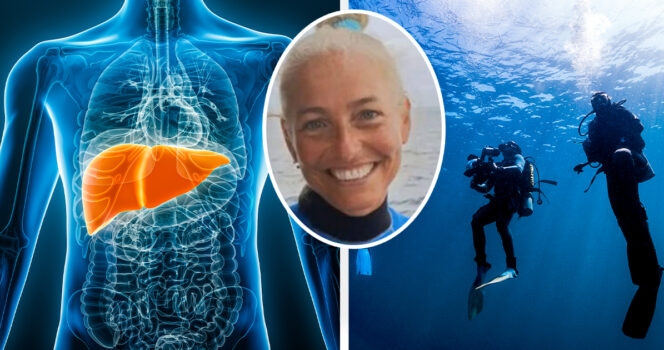
All five bodies of the Italian scuba divers who were killed in the Maldives last week have been recovered. Exactly what happened is not yet concluded; however, what we do know is that they died in the infamous ‘shark cave.’ So what really happens to the body when dying underwater? Here’s all you need to know about the terrifying event that occurs.
On early Wednesday, the last two bodies of the Italian divers killed in the Maldives were recovered, a government spokesperson said per Reuters, completing recovery efforts.
The divers were among a group of five who swam into a deepwater cave for exploration last week in the Vaavu Atoll. The group had been exploring a series of underwater caves at a depth of around 50 meters (165 feet), according to a statement from the foreign ministry. The tragic event is the deadliest-ever diving accident in the Maldives.
The divers had been granted the necessary permit needed to research soft corals.
Maldivian authorities are now investigating what caused the horrifying deaths of the divers. There are multiple causes, with one theory being that they descended deeper than they thought, becoming lost in the cave system.
Exactly how long the divers had been dead for is not yet known. However, what is known is what happens to the body when drowning, including decomposition, which differs in wet environments.
What happens to the body when drowning
When a person is underwater and cannot breathe, the body reacts very quickly because it is being deprived of oxygen.
Per an article published by the American Academy of CPR and First Aid, under certain conditions, drowning can happen in just a few seconds. In many cases, a person may lose consciousness within 1 to 3 minutes of submersion, depending on factors such as age, overall health, and water temperature.
After 4-6 minutes, the brain starts to take damage if oxygen isn’t restored. It is possible that the heart is still beating for a short time; however, it becomes weaker and beats irregularly. The body responds to drowning when the brain detects a lack of oxygen (hypoxia).
The nervous system activates protective mechanisms, prioritizing blood flow to vital organs such as the heart and brain. This is why basic life support training is essential for rescuers.
So would the divers have been conscious as they were drowning, or did they black out? Per the American Academy of CPR and First Aid, loss of consciousness during drowning usually doesn’t happen straight away. Instead, it often occurs after a period of heavy breathing or hyperventilation. At first, many people are still fully aware of what is happening.
Internal and oxygen-related changes in the first 24 hours
The body’s natural instinct to hold the breath can delay water from entering the lungs for a short time. However, as panic increases, breathing becomes more difficult, and the airway can eventually become blocked.
Within the first 24 hours, the main changes in the body are internal and oxygen-related, so any decomposition doesn’t occur. Visible decay usually takes longer and depends heavily on temperature, water movement, and other conditions; however, bodies in water can be affected by different insects and animals than those on land.
The early changes include water in the lungs and airways, organ damage from oxygen deprivation, pale skin, a cold body, and muscles gradually becoming stiffer, depending on the conditions.
So, what about how the body decomposes in water? In a 2017 study by James L. Caruso, MD, Chief Medical Examiner and Coroner for the City and County of Denver, decomposition in a wet environment differs from that in other settings and proceeds at a different rate.
Decomposition
He explains that changes that occur in a body after death are not solely determined by water temperature. Things like water currents and natural or man-made objects in the water can also change how a body looks or is preserved.
When a body is underwater or in a wet environment, it breaks down in a low-oxygen setting. This can sometimes lead to a process called adipocere, in which body fats slowly turn into a wax-like substance due to bacterial activity.
Bodies in water are also affected by different insects and animals compared to those on land. Scavengers can create damage on the body that may look like injuries, but is actually caused after death. This is why these changes must be carefully examined.
Our thoughts and prayers are with the families of the late divers. Rest in peace.



0 Comments